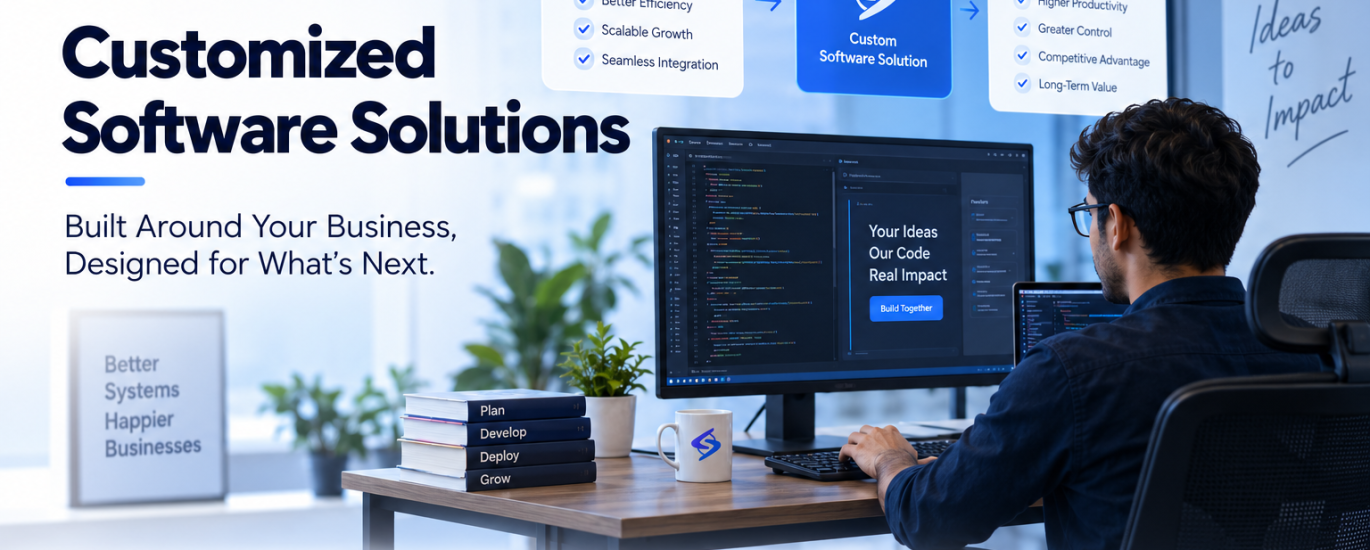
Customized software solution is a service where software is designed specifically around the needs, workflows, and goals of a particular business. Unlike generic tools, custom software development allows companies to build features, integrations, and processes that match how they actually operate. The result can be significant custom software benefits, including better efficiency, scalability, integration, and control.
But what exactly is customized software, and when should a business consider building one?
Let’s break it down.
What Is Customized Software Solution?
Customized software is an application developed specifically for a particular organization, industry, or business process.
Instead of asking a company to change its workflow to fit existing software, customized software solutions are designed to fit the company’s workflow. That’s what we, SyncersIT do!
For example, a retail business might need a system that combines:
- Inventory management
- Sales tracking
- Supplier management
- Customer management
- Purchase orders
- Accounting integration
- Sales reporting
A ready-made application may provide some of these features, but it may not work exactly the way the business operates. A customized system can bring these requirements together into one platform.
This is the fundamental difference between custom software and off-the-shelf software.
What Is Custom Software Development?
Custom software development is the process of planning, designing, developing, testing, deploying, and maintaining software specifically for a business or organization.
The development process usually begins by understanding the company’s problems and requirements. Developers then design a solution around those requirements.
A typical custom software development process includes:
- Business and requirement analysis
- Software planning
- UI/UX design
- Software development
- Testing and quality assurance
- Deployment
- Training and implementation
- Maintenance and future updates
This approach means the final system is not simply a collection of unnecessary features. Instead, it is built around the organization’s actual needs.
Current software-development resources similarly describe custom software as applications created for a specific organization rather than a broad market.
Customized Software Solutions vs. Off-the-Shelf Software
One of the most important questions businesses ask is whether they should purchase ready-made software or invest in customized software solutions.
The answer depends on the complexity and uniqueness of the business.
| Customized Software | Off-the-Shelf Software |
|---|---|
| Built around specific business requirements | Built for a broad market |
| Highly flexible | Limited customization |
| Can integrate with existing systems | Depends on available integrations |
| Can scale with specific business needs | Depends on vendor’s roadmap |
| Higher initial development investment | Usually lower initial cost |
| Greater control over features | Vendor controls product roadmap |
Off-the-shelf software can be an excellent choice when your requirements are standard. However, problems can arise when your business processes are significantly different from the software’s default workflow.
That’s where custom software development becomes valuable.
Key Custom Software Benefits
There are several important custom software benefits that can make customized solutions a worthwhile investment.
1. Software Designed Around Your Business
The biggest advantage is simple: the software is built around your business.
Instead of changing your processes to accommodate software, the software can be designed around your processes.
For example, a wholesale company may have a unique pricing structure based on:
- Customer type
- Order quantity
- Product category
- Payment terms
- Geographic location
A customized system can automate these rules instead of forcing employees to calculate them manually.
2. Better Business Process Automation
Manual tasks consume time and increase the possibility of human error.
Customized software solutions can automate repetitive processes such as:
- Invoice generation
- Order processing
- Inventory updates
- Employee approvals
- Customer notifications
- Report generation
- Data entry
This allows employees to spend less time on repetitive administrative work and more time on activities that actually grow the business.
3. Greater Scalability
Businesses change over time.
You may start with a small team and a few hundred customers. A few years later, you may have multiple branches, thousands of customers, and significantly more transactions.
One of the major custom software benefits is that the system can be designed with future growth in mind.
New modules, users, integrations, and features can be added as the business evolves.
4. Seamless System Integration
Businesses often use several different systems for different functions.
For example:
Website → CRM → Inventory → Accounting → Payment Gateway
If these systems don’t communicate properly, employees may have to enter the same information multiple times.
Customized software solutions can be developed to connect different systems and synchronize information between them.
This can reduce duplicate data entry and create a more consistent flow of information.
5. Improved Productivity
Software should make work easier—not create more work.
When employees have to navigate through unnecessary features or perform multiple workarounds, productivity can suffer.
Custom software development allows businesses to create interfaces and workflows based on what employees actually need.
For example, a sales employee might see:
Customer → Products → Order → Payment → Confirmation
instead of navigating through several unrelated menus.
Small improvements like these can make a major difference when employees perform the same task hundreds of times.
6. Better Control Over Data
Businesses often need different levels of access for different employees.
A customized application can implement role-based access.
For example:
- Admin → Full access
- Manager → Reports and operational access
- Sales employee → Customer and sales access
- Warehouse employee → Inventory access
- Accountant → Financial access
This gives businesses greater control over who can access specific information.
7. Competitive Advantage
Your competitors can purchase the same generic software you use.
But they cannot necessarily replicate software that has been specifically designed around your business processes.
This is another important custom software benefit.
A company can use technology to create unique workflows, customer experiences, dashboards, automation, and internal processes that differentiate it from competitors.
8. Long-Term Flexibility
A software vendor’s roadmap may not always match your company’s roadmap.
A feature you need might not be available. A feature you don’t need might be added instead.
With customized software solutions, your development roadmap can be based on your own business priorities.
That makes the software easier to adapt as your business changes.
Examples of Customized Software Solutions
Customized software can be used across almost every industry.
Here are some practical examples.
1. Custom Inventory Management Software
A wholesale or retail company may require a system to manage:
- Products
- Stock levels
- Purchase orders
- Suppliers
- Sales
- Returns
- Warehouses
- Low-stock alerts
Instead of using several disconnected tools, the company can develop a custom inventory management system around its specific workflow.
2. Custom CRM Software
A business with a unique sales process may need more than a standard CRM.
A custom CRM can include:
- Lead management
- Customer profiles
- Sales pipelines
- Follow-up reminders
- Sales reports
- Automated notifications
- Customer communication history
The system can be designed specifically around how the company’s sales team works.
3. Custom ERP Software
ERP systems bring different business functions together.
A customized ERP may include:
- Accounting
- Inventory
- Procurement
- Sales
- HR
- Payroll
- Production
- Reporting
This is particularly useful for organizations with complex internal processes.
4. Custom E-Commerce Software
A business may require an e-commerce platform with functionality that standard platforms cannot easily provide.
For example:
- Wholesale pricing
- Dealer accounts
- Custom product configuration
- Special payment rules
- Complex shipping logic
- Multiple warehouses
- Customer-specific pricing
These requirements can be addressed through custom software development.
5. Custom Employee Management System
Companies can also develop customized employee management software for:
- Attendance
- Leave management
- Payroll
- Employee records
- Performance tracking
- Recruitment
- Department management
The system can be designed according to the organization’s internal HR policies.
6. Custom Healthcare Software
Healthcare organizations may need specialized systems for:
- Patient management
- Appointment scheduling
- Medical records
- Billing
- Doctor management
- Laboratory management
- Patient communication
Because healthcare workflows can be highly specialized, customized software solutions can provide a better fit than generic tools.
7. Custom Real Estate Software
A real estate company may need software to manage:
- Property listings
- Leads
- Sales representatives
- Customer information
- Booking
- Payments
- Installments
- Property availability
- Sales reports
A custom platform can bring these functions together into one system.
When Should a Business Choose Custom Software?
Customized software is not automatically the best choice for every business.
A ready-made solution may be perfectly suitable if your requirements are simple and already supported by an existing platform.
However, custom software development may make sense when:
- Your business has unique workflows
- Existing software requires too many workarounds
- You need several systems to communicate
- Your business is growing rapidly
- You need specialized features
- You require greater control over data
- Your industry has specific requirements
- Existing software limits your productivity
The key question is not simply:
“Can we afford custom software?”
A better question is:
“How much is our current software costing us in inefficiency, manual work, errors, and missed opportunities?”
How Much Does Customized Software Solution Cost?
There is no universal price for customized software solutions.
The cost depends on factors such as:
- Number of features
- Software complexity
- Number of users
- Web or mobile requirements
- Third-party integrations
- UI/UX requirements
- Security requirements
- Development timeline
- Maintenance requirements
A simple internal business application may cost significantly less than a complex ERP, marketplace, or enterprise platform.
That’s why a proper requirements analysis should come before receiving a development quotation.
Custom Software Benefits vs. Initial Cost
One common concern is that custom software requires a larger initial investment than many ready-made applications.
That’s true in many cases.
However, businesses should evaluate the total value rather than looking only at the initial development cost.
Suppose employees spend several hours every week:
- Entering the same data
- Creating manual reports
- Moving information between systems
- Correcting data-entry errors
- Performing repetitive calculations
A customized system could automate many of these processes.
Over time, the productivity gains may justify the initial investment.
Custom software should therefore be viewed as a business investment rather than simply another software expense.
Final Thoughts
Customized software solution are designed to solve specific business problems instead of forcing businesses to adapt to generic software. Through custom software development, companies can build applications around their workflows, integrate existing systems, automate repetitive tasks, and create technology that can evolve with the business.
The most important custom software benefits are not simply having unique software. The real value comes from solving the right problems—reducing manual work, improving productivity, connecting systems, controlling data, and creating a technology platform that supports long-term growth.
If your current software is forcing your team to constantly find workarounds, it may be time to consider whether a customized solution would be a better fit.
Frequently Asked Questions
What is a customized software solution?
A customized software solution is software specifically designed and developed for the requirements, workflows, and objectives of a particular business or organization.
What are the main benefits of custom software?
The main custom software benefits include better flexibility, business process automation, scalability, system integration, productivity, data control, and the ability to create unique business capabilities.
What is the difference between custom software and off-the-shelf software?
Custom software is developed for specific business requirements, while off-the-shelf software is designed for a broad group of users with relatively standard needs.
Is custom software development expensive?
The cost varies depending on the features, complexity, integrations, users, and development requirements. A simple application can cost much less than a complex ERP or enterprise platform.
Who needs customized software solutions?
Businesses with unique workflows, complex processes, integration requirements, or limitations with existing software are the strongest candidates for customized software solutions.
Can custom software integrate with existing systems?
Yes. Custom software can be designed to integrate with systems such as CRMs, ERPs, accounting platforms, payment gateways, websites, mobile applications, and other business tools.